three stacks of high society


Engineer and open source software advocate living and working in Austin, Texas

life

From CET to CDT

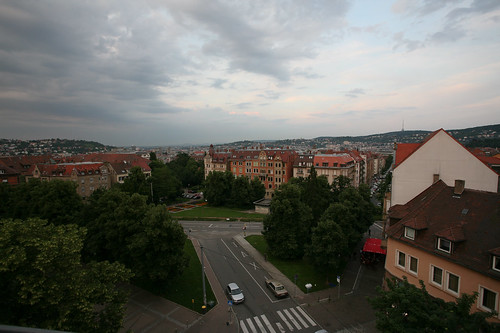
View from Bismarckstrasse

Memory is really strange. On the one hand, I'm amazed at how fast the last three years of my life has gone by. I remember walking into my hotel room on the day I landed in Stuttgart, a full month before Rebecca would come, and putting down my bags and really wondering what I had gotten myself into. I had decided to take a job in a city I had visited only during my interviews, in a country I had only spent a few days in as a tourist, and here I am sitting down in my hotel room, in need of a shower, exhausted from jet-lag, only then grasping that I had committed myself and Rebecca to living in Stuttgart for at least three years. At that moment I could only hope that we had made the right choice to come. It turned out to be one of the best decisions of our lives.

Remembering specific events, though, and time doesn't seem to move so quickly. I think about my first weekend in Germany, when a colleague invited me to an Onion Festival in the medieval town of Esslingen, and it seems appropriately placed about three years ago. Then I remember when our friend Laurel visited, our first visitor, I think, and how we went out to a besenwirtschaft (a uniquely south-west Germany gem, in which vineyard-owning families sell their own wine out of their living rooms) and got extremely intoxicated with a super friendly German couple. We ended up getting invited to their home for a few more bottles of wine, and Rebecca got sick in their bathroom just as our taxi pulled up. I remember all of the festivals - the Hamburg Fischmarkt, Karnival, the Weindorf, and of course the Bierfests (Germans love to find a reason, any reason, to have a festival). I remember all our visitors - our families and lots of friends from home - who took advantage of us living in Stuttgart and allowed us to share our newly found love of Germany with them. I think fondly of all the trips we took - the Turin Winter Olympics, Sardinia, the Lake District, Poland, and so many more. The more memories I conjure up and place into a mental timeline, the more it seems like it really has been three, full, years since I stepped into my room at the Millennium Hotel, and I'm both at once happy for the experience and sad that I can no longer call Stuttgart home, even if it means I no longer have to walk up 6 flights of stairs to be home.

We hope to go 2 for 2 on picking cities randomly and moving without any prior connection, and so far Austin has really been a great place. Many great things about German culture are embraced in Austin - love for the outdoors and festivals being the two most obvious. There are even biergartens, and the town of Fredricksburg, located in the center of Texas wine country (another huge similarity to Stuttgart!), was founded by Germans, and I think the German influence on the local culture shows. There's even a local waterpark called the Schlitterbahn.

I think we're off to a good start.

FOSDEM over; Crisis averted

lots of beer on tap

I went to Brussels last weekend for FOSDEM 2008, which was held at ULB Campus Solbosh. The free event was a good way to check in with the overall Open Source community and to see all of the interesting things people outside my normal circles are working on.

Friday Night Beer Event
Things got off to an memorable start on Friday night. I timed my arrival so that I could attend the Friday night "Pink Elephant" beer event held at the Delirium Cafe. I met up with a colleague, and we had a few good beers while chatting with other FOSDEM attendees. Lots of people had their gadgets out for others to play with. I got to play with a EeePC and a Nokia 810 while my iPhone was passed around. I even picked up the presence of a OLPC OX-1 over wifi, but was never actually able to find it.

After a few hours of drinking beer and talking about software, we met up with a few more friends to go to dinner at an underwhelming yet wistfully overpriced restaurant in the middle of the tourist trap. I had another beer or two over dinner, and so when we left the restaurant, I was a little toasted.

For some reason (playing with my phone?) I was straggling behind as we walked out when these two guys sidled up to me and started dancing, singing yelling, and doing some weird line dance kick between my legs. In my drunken state, I was a bit confused but thought they were just drunk too and danced along. After a few moments of this silliness, they walked off. I luckily had a moment of clarity and thought it best to check my pockets. Wait, my wallet is missing. Yup, it really is still missing. The two guys hadn't taken more than 20 steps down the street, so I ran up to the nearest one, forcefully grabbed his shoulder, and demanded, "Give me back my wallet." He looked a bit surprised and immediately pointed to his accomplice. I turned to him and without a word, he reached into his coat pocket and handed over my wallet. I took it from his hands, and strangely enough, we just parted ways. The entire episode lasted probably 30 seconds or so, and my friends, who were only a few steps ahead, missed it all.

Talks
The next morning I was a bit slow getting up and got to FOSDEM about an hour late, missing the opening keynote (it didn't help that I stayed up for a few more hours playing poker with the hotel staffer and his friends, but that's another blog post). I pretty much spent Saturday in the Janson auditorium listening to the big talks - "How a large scale opensource project works" with Robert Watson, "Perl 6" with Patrick Michaud, and "Unicoding with PHP 6" with Andrei Zmievski. I also squeezed in some quick 15-minute "lightning" talks about smaller open source projects like Alfresco, OpenAFS, and Squeak.

I was even slower getting up on Sunday morning* and missed the Drupal opening talks by Dries. I did catch Kris Buytaert's "Drupal and MySQL High Availability", which was quite good. In addition, I took the opportunity to see a talk on CakePHP and Mozilla's upcoming Prism.

Thoughts
My colleagues in attendance weren't too enthusiastic about this year's FOSDEM. Their main complaint was that it has become a little too commercialized with seemingly marketing-oriented talks, rather than more in-depth code talks. While I can understand this sentiment, I think the problem is mainly with their expectations of FOSDEM. FOSDEM should be a venue for projects to open up to people outside of their core community. A code-driven, detailed talk about the intricacies of the Form API in Drupal 6, for example, would only be digestible by experienced members of the Drupal community, most of whom would be familiar with the FAPI in the first place. Higher-level talks allow small projects, such as Squeak and CakePHP, to attract people like me who have a passing interest and may even be pulled in enough to try the stuff out.

Some of the speakers were certainly better than others. FOSDEM (and Open Source in general) is a pretty international affair, and because the conference was conducted in English, there were varying levels of English public speaking abilities. Overall, however, I thought the speakers were quite good and spoke to the subject matters well. My only complaint is that FOSDEM seems to be outgrowing its britches. There were lots in attendance, and at times, it was a little bit difficult walking through the masses to get to the talks in time. That probably speaks to the growing popularity of OSS, which is always a good thing.

More photos from FOSDEM 2008.

*I discovered the Grand Casino Brussels on Saturday night and was there until almost 4 in the morning waiting on a seat at the Hold 'em table. Generally casinos in Europe are quite stuck up about dress code and appearances (to the point of making you rent an evening jacket), but I found Brussels casino to be very welcoming. You still won't find flip-flops and t-shirts like you would at some places in Vegas, but at least you can walk in reasonably dressed. Anyway, at 11PM I was #3 in line for a seat and only got to #1 by 3:30am before I had had enough and just left. They had two tables of €5/€10 NL Texas Hold'em, but apparently they sometimes also have €10/€20 limit as well.

Technology is Applied Magic

A few hours ago, Rebecca and I were walking through the Schwabstrasse S-bahn stop in Stuttgart, and as we reached the escalator to go up, we felt a cold wind coming down from the street level.  I was wearing only a short-sleeve polo shirt and a pair of light pants, and so we stopped to put on warmer clothing.  Only a few hours earlier, we were having paella on a warm Malvarrossa beach in Valencia, Spain.

As we were putting on our jackets and gloves, Rebecca made a comment that reminded me of one of Arthur C. Clarke's three laws:

Any sufficiently advanced technology is indistinguishable from magic.

She observed that we had not been outside since stepping out of our friends' car and into the Valencia airport, and had we instead taken the Valencia metro to get to the airport, we would have been able to step underground in downtown Valencia and then return above ground in downtown Stuttgart, having not been outside and exposed to any sort of weather or natural light the entire distance across three countries. We were completely comfortable in the clothing we wore in the warm Valencian weather up until the point of reaching the Stuttgart street level, and that to me is amazing.

So I was pleasantly surprised as I came across this image while catching up on some of my RSS feeds:

Transit Map of the World’s Transit Systems

It's a great little drawing, based on the London Tube map, that shows all of the worlds metropolitan mass transit systems either currently in existence or in the works.

The culmination of our technology, ranging from efficient metro systems to air travel to client control systems, is indistinguishable from magic for nearly everyone who's lived before the 20th century (and even for certain people living in the 21st century, for that matter).

Image via strange maps.

A downside of VoIP

I live in Germany but maintain a US-based VoIP number through a VoicePulse.com account. The VoIP account allows Rebecca and me to cheaply call the US, and gives our friends and family a "local" US number at which they can reach us in Germany. I've got a standard digitally cordless analog phone (heh) that plugs into a Fritzbox supplied by my ISP - 1und1.de. The Fritzbox is a wonderful piece of kit that works as a DSL modem, DHCP-enabled router, WIFI AP, and has two analog telephone adapters (ATAs) built-in. Since 1und1 gives us a free German VoIP number, the FritzBox handles three incoming and outgoing phone lines - my VoicePulse US number, my 1und1 Germany number, and my standard analog line supplied by Deutsche Telekom. Any incoming call lights up all phones connected to the FritzBox. Add in mine and Rebecca's mobile phones, and in one apartment we have five phone numbers between the two of us. It only seems slightly overkill.

The downside to all of this global connectivity is that people can no longer assume we're physically tied to a location based on our phone number. When I signed up with VoicePulse, I chose a Charleston, South Carolina area code + prefix. A few years ago, this number identified you to a certain area determined by your phone company. Now, with US number portability and VoIP, locations and numbers are completely detached. My Voicepulse number can ring at a Starbucks in Hong Kong just as well as it does here in Stuttgart.

Quite often our US line will ring anywhere from midnight to 2AM CET, which means we're likely already in bed or about to be. Midnight to 2AM CET is 6:00-8:00 PM EST - prime-time for telemarketers or overly eager bank representatives to call. I usually just conduct whatever business they are calling to conduct and then politely explain that they're actually calling Germany, and that I'm anywhere from 6 to 9 hours ahead of them. "Please note this in your system," I would say. That seems to work well enough.

Stuttgart's Besenwirtschaften

Stuttgart MoonStuttgart has these wonderful little hidden little charms that make it a really great place to live. One of our favorites are the Besenwirtschaften, which are traditional Swabian wine houses. They're operated by the families that own the numerous vineyards around the Stuttgart area, and by law they are allowed to open 4 months out of the year. They are scattered throughout the city and its surrounding towns, and if you find one you can enjoy very simple (and cheap) Swabian food and fresh wine from that year.

One of my favorites is a place in Degerloch that a German woman introduced me to. It is essentially a living room that overflows into a side room, so the atmosphere is wonderfully warm and intimate. At the most, 20-30 people pack into these two small rooms, and the close quarters means that you are forced to meet and talk to your fellow wine drinkers. Two out of the three times we've been there, we've had Germans who were young kids during WWII come tell us about their first experience eating bananas and oranges given to them by American GIs. It really is quite nice of them to tell us this, and it makes us feel welcomed in Stuttgart, where our social circle mainly revolves around the large community of expats working for the many international companies based in Stuttgart.

Anyway, so we went last Saturday, which happened to be the same night as the big lunar eclipse. Between 5 of us, we had about 6 liters of wine, so by the time the U-Bahn got me home, I wasn't as steady as I needed to be to take some good eclipse photos. I managed to shoot two frames before passing out. My next one is really a drunken picture, and the following night I took a few more frames since my camera was already out.

Syndicate content

Random Flickr photos

porto, portugalimg_8258.jpgporto, portugalIMG_7757.JPGMercedes & Rebecca0146.jpg

Blame me for

ClemsonTALK - Clemson's largest forum
Clemson Wiki Project - Clemson oriented Wiki